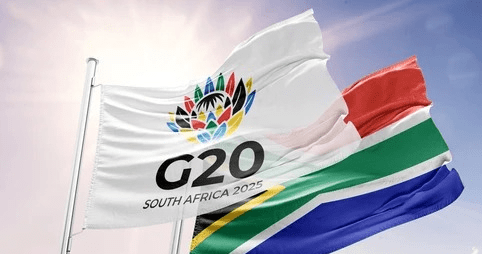
Johannesburg, Nov 23, 2025 — South Africa received strong international recognition after the conclusion of the Nasrec Summit, which marked Africa’s first time hosting the Nasrec G20 on November 22–23. World leaders applauded President Cyril Ramaphosa for his diplomatic approach, praised the seamless organisation of the event, and highlighted the summit’s commitment to Global South inclusion, climate financing, and strengthened AU–EU relations. Analysts say the gathering elevated South Africa’s profile as a trusted and effective global mediator.
Inside the Nasrec Summit: Key Themes and Milestones
The Nasrec Summit brought together heads of government, ministers, economists, and major global institutions for two days of detailed discussions. As the inaugural G20 held on African soil, it symbolised a shift in global governance—placing Africa at the centre of high-level decision-making.
Discussions centred around several major themes:
- Rebuilding global financial systems to support emerging markets
- Scaling climate adaptation, renewable energy, and resilience funding
- Reducing debt pressure on vulnerable economies
- Accelerating digital transformation for the Global South
Delegates consistently highlighted how well-prepared the Nasrec precinct was—citing its efficient transportation planning, advanced security coordination, and modern facilities.
A senior Asian representative remarked, “The Nasrec Summit demonstrated South Africa’s ability to deliver a world-class event that met the highest global standards.”
US Absence Didn’t Slow the Summit’s Progress
Although the United States did not participate this year, the summit moved ahead with full momentum. Key global powers—including the EU, India, China, Brazil, the African Union, GCC states, and ASEAN countries—remained actively involved throughout the discussions.
Experts noted that the absence of the US opened the space for:
- More unified Global South leadership
- Deeper focus on development issues
- Greater Africa–Asia–Latin America collaboration
- Reduced geopolitical tension in climate negotiations
Instead of weakening the summit, the US absence highlighted how resilient and diverse global cooperation has become.
A policy analyst commented, “The Nasrec Summit showed that global progress can continue even when one major power is missing. The Global South filled the leadership gap with confidence.”
Ramaphosa’s Leadership Stands Out Worldwide
President Cyril Ramaphosa emerged as a central figure at the Nasrec Summit, receiving consistent praise for his calm, inclusive, and results-oriented leadership. He guided complex negotiations, mediated between differing political positions, and ensured the summit delivered strong outcomes.
Ramaphosa’s key achievements included:
- Securing pathways for more than $100bn in green energy and climate funds
- Leading calls for fairer and more flexible lending from global financial institutions
- Championing African industrial growth, digital development, and innovation
- Strengthening AU–EU cooperative frameworks for trade, migration, and energy
International publications highlighted Ramaphosa as a stabilizing presence during a challenging global period.
An EU envoy said, “President Ramaphosa provided steady leadership that kept the summit focused, constructive, and forward-looking.”
Global South Priorities Take Centre Stage
One of the defining successes of the Nasrec Summit was its strong emphasis on giving developing nations a greater voice in global decision-making. For the first time, African, Asian, and Latin American concerns shaped nearly every discussion.
Key commitments included:
1. Reforming Global Financial Governance
Countries agreed on the need to modernize the IMF and World Bank to give more power and representation to developing economies.
2. Supporting Debt-Burdened Nations
Leaders discussed new frameworks to help countries facing high debt levels through coordinated restructuring mechanisms.
3. Expanding Digital Infrastructure and Access
Funding for digital literacy, broadband expansion, and technology innovation was prioritised for lower-income regions.
4. Boosting Climate Adaptation in High-Risk Areas
The summit reinforced the need for investment in water security, early-warning systems, and climate-resilient agriculture.
Delegates described the summit as a major step toward correcting long-standing inequalities in global policy frameworks.
Climate Agreements Gain Strength Despite Global Challenges
Environmental commitments were among the standout achievements of the Nasrec Summit. Delegates across continents reaffirmed their dedication to climate action, even with geopolitical uncertainties.
Major outcomes included:
- Investment in renewable energy corridors and clean power infrastructure
- Support for drought-resistant agriculture and water conservation
- Funding for electric mobility and low-emission transportation
- Additional contributions to climate adaptation and disaster-preparedness programs
Climate observers praised the summit for pushing ahead with meaningful climate action despite the absence of the United States.
A German climate negotiator commented, “Nasrec proved that global climate cooperation is no longer dependent on any single country.”
AU–EU Partnership Plans Accelerate After the Summit
One of the clearest long-term outcomes of the Nasrec Summit was the strengthening of African Union–European Union cooperation. Multiple strategic frameworks were introduced or expanded, designed to support Africa’s economic and digital growth.
Key AU–EU follow-up programs include:
- Trade and investment cooperation forums
- Support for African digital transformation and innovation hubs
- Talent mobility and migration management programs
- Joint development of green energy infrastructure
- Expansion of pharmaceutical and vaccine manufacturing in Africa
These initiatives position South Africa as a continental diplomatic anchor, helping guide Africa–Europe engagement into the next phase.
Social Media Reactions Highlight Pride and Optimism
Social media engagement surrounding the summit was strong, with hashtags like #NasrecSummit, #G20Africa, and #G20Johannesburg gaining traction across Africa and beyond.
Users highlighted:
- Pride in South Africa hosting a major global event
- Appreciation of Ramaphosa’s diplomatic leadership
- Interest in Africa’s role in shaping global decisions
- Positive feedback on the focus on climate resilience and development
Thousands of posts emphasized how historic it was to see Africa leading discussions traditionally dominated by Western powers.
What Comes Next After the Nasrec Summit?
South Africa has outlined the next steps for turning summit commitments into action.
Upcoming developments include:
- Release of the Johannesburg G20 Implementation Roadmap
- Launch of climate finance deployment projects
- Activation of AU–EU digital and economic programs
- Establishment of technical working groups to coordinate progress
- Public updates scheduled throughout 2026
Experts predict the Nasrec Summit’s follow-up actions will shape Africa’s global influence for years.