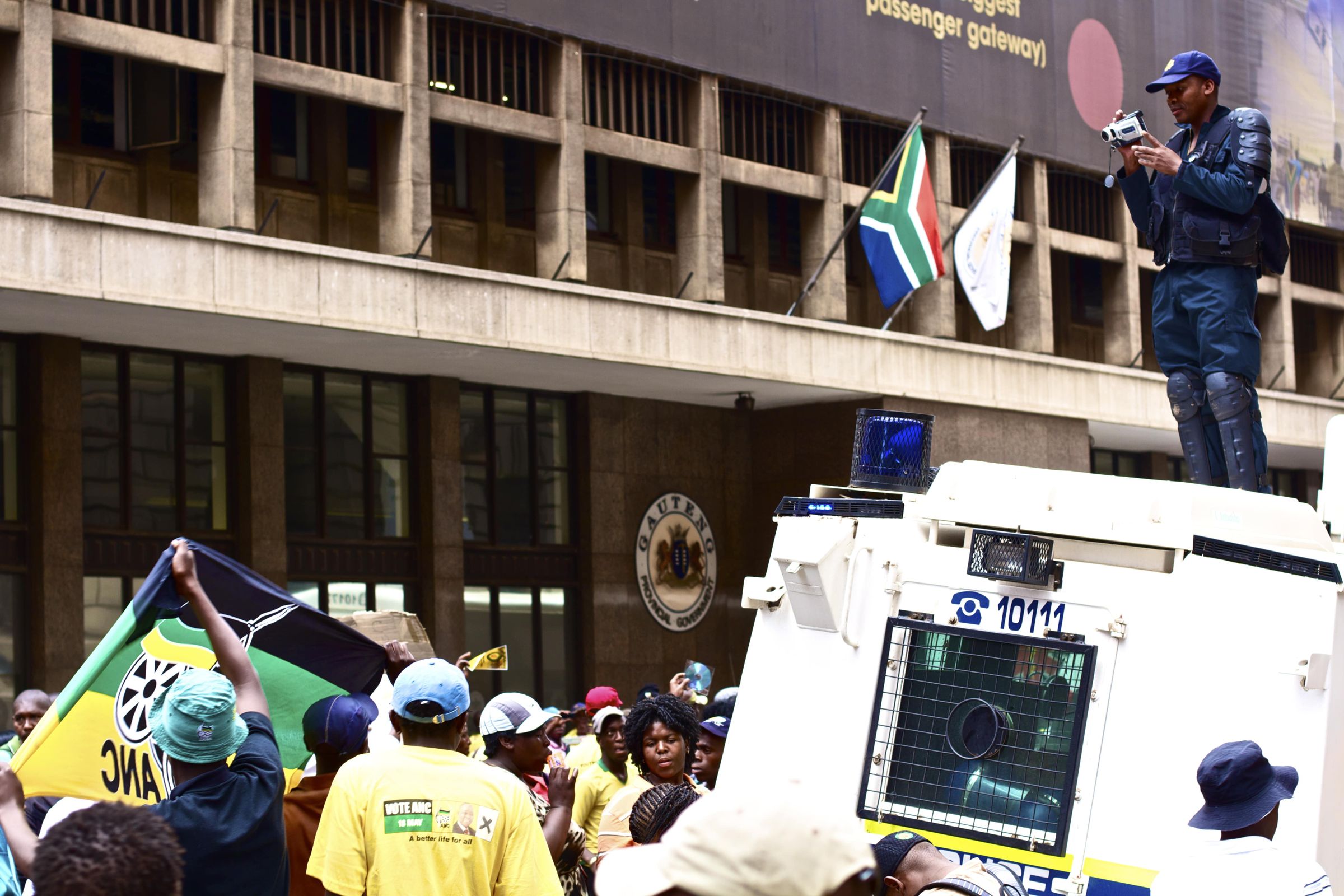
For residents of Johannesburg and Cape Town, the coming local government polls will decide more than party politics. They will determine who fixes the pipes, who fights the crime on their streets, and who answers for the state of the cities they live in. Yet as the ANC and the DA, the two leading partners in the government of national unity, prepare to face off at the ballot box, experts say the real test may come after the votes are counted, in the coalition negotiations that could shape daily life for millions.
Independent election analyst Michael Atkins believes the significance of the polls will lie in how parties conduct themselves during those negotiations. “We need to build a culture of respect across divides, where the needs of voters are prioritised over short-term interests,” he said. For voters in the metros, that culture could mean the difference between functioning councils and prolonged instability.
The numbers suggest the ANC faces an uphill battle in Johannesburg. Public opinion polls show the party dropping below 30% in the metro. Atkins warned that a key implication would be the possibility of an overhang, where the ANC retains more wards than its total proportional representation seat allocation. That gap could be as high as five seats, meaning the ANC would hold ward seats without corresponding PR councillors.
In Cape Town, the picture is more complicated. Despite a decline in DA support nationally, the party’s provincial results in 2019 and 2024 were better than at national level, pointing to a core of local support that remains intact. Professor Sethulego Matebesi of the University of the Free State, head of the department of sociology, predicts a hung council in Johannesburg, citing the MarkData poll, which placed the DA at 35% and the ANC at 21.8%.
But Matebesi cautions that polls like this struggle to model who will actually vote in low-turnout local elections. “While the DA will do well in Johannesburg, it will keep its mayoralty of Cape Town. But an outright majority is uncertain in Cape Town,” he said. Parties like the Patriotic Alliance will garner significant electoral support, something that will decrease the DA’s share. For that reason, he argued, a high turnout matters more than any campaign issue. He also noted that black voters have openly associated themselves with parties like the Freedom Front Plus, and it will be interesting to see what impact this shift has on the outcome.
Meanwhile, with DA Johannesburg mayoral candidate Helen Zille having ruled out a coalition with the EFF and the uMkhonto weSizwe Party, the ANC is set to be a perfect partner. “The DA is polled at about 35% and ActionSA 10%, even together falling short of a majority. Rough poll shares are not seats. Combinations with enough weight to govern are the DA plus the ANC or the DA with several smaller parties,” Matebesi explained. The first option is more stable but politically costly for both parties. The second depends on repairing the Zille-Mashaba relationship. A broad ANC-led alliance of MK, EFF and ActionSA is arithmetically possible, but would be hard to hold together.
On the ground, the stakes feel sharpest for communities on the Cape Flats and in the townships, where high crime levels have put the DA on the back foot. Much of the debate has been driven by the party’s mooted plan to spend millions on building a 9km concrete barrier along the N2 highway between Baden-Powell Road and Bhunga Avenue. Matebesi noted that 45.3% of people in Cape Town blame the national government for gangsterism, against 25.3%, limiting the damage to the DA. Whether the wall is racially divisive, he said, is a value judgement, and public opinion appears to split depending on where people live. The DA has been accused of prioritising affluent suburbs, while its supporters say black residents get better services where it governs.
Dr Oscar van Heerden, a research associate and senior research fellow at the University of Johannesburg’s Centre for African Diplomacy and Leadership, opposes the wall as a means to fight crime. “It is a dangerous precedent, creating prison-like territories in and around the city, least curbing crime,” he said. He added that Helen Zille and the people of Johannesburg seem to have forgotten that the DA, after 2016, ran a number of metros and yet could not turn those cities around. Regarding spending on affluent suburbs compared to poor black townships, he said the DA has been exposed for inadvertently maintaining the apartheid spatial morphology, having done very little to ensure integration in housing and socio-economically.
By contrast, Zille has announced the DA’s key priorities for the financially ailing Johannesburg: fixing the city’s finances, putting honest and capable people in charge, declaring war on corruption, making the municipality work for residents, and restoring law and order. The ANC has pledged to turn around municipal service delivery, with key targets in its first 100 days including investing at least 8% of municipal asset values into maintenance and renewal, and having 50% or more municipalities achieve clean or unqualified audits. It has also pledged to redouble efforts to fight crime.
Whichever combination of parties emerges from the negotiations, the stakes for residents are concrete: who governs their cities, and whether the promises made on the campaign trail translate into services on the ground. Further analysis of the ANC-DA face-off is available at https://mg.co.za/politics/2026-10-29-inside-the-anc-da-poll-face-off/