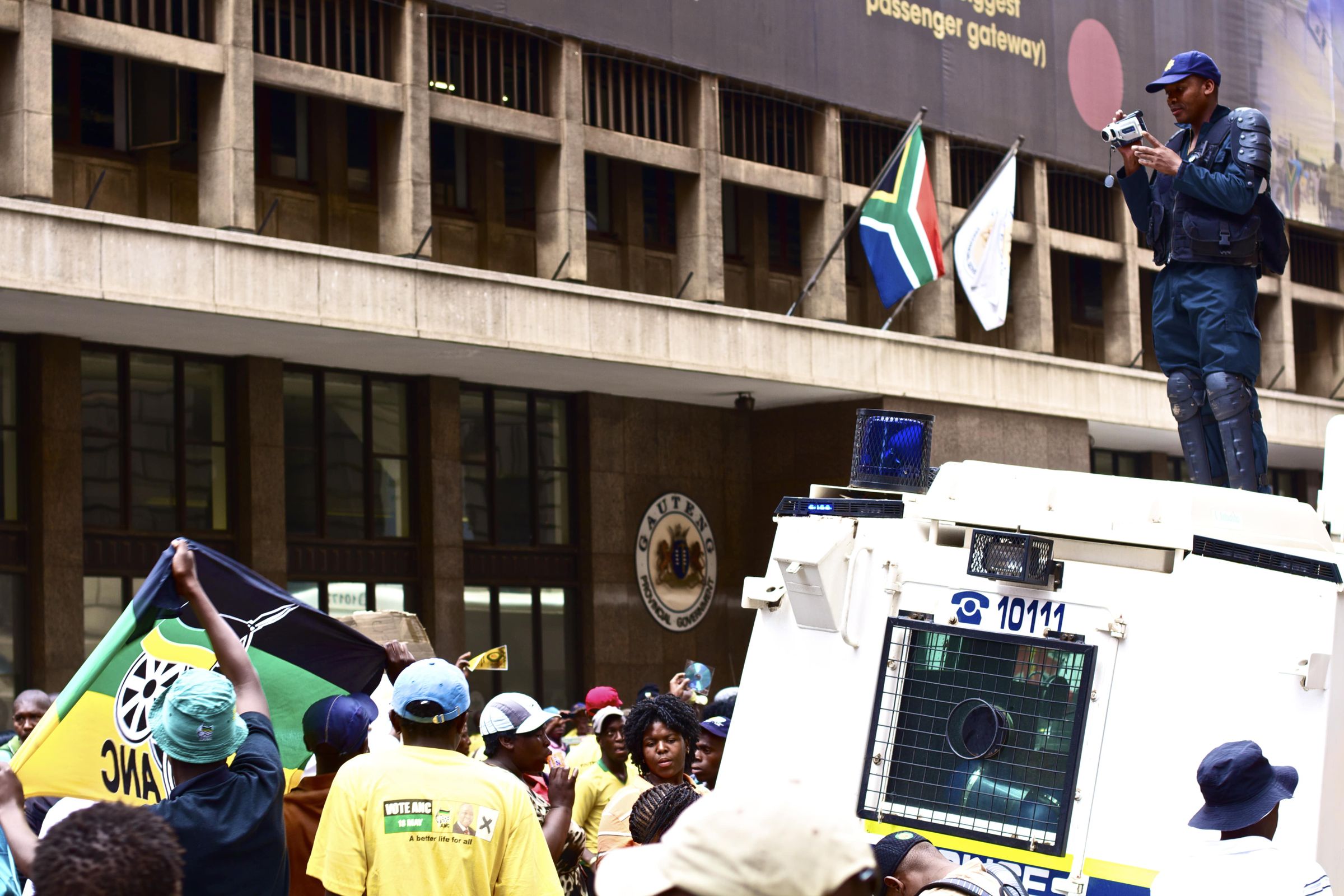
The African National Congress stood at 31.8% of the national vote on Sunday as South Africa’s electoral commission prepared to announce final local election results, a figure that puts the party on course for its weakest national showing since it took power at the end of apartheid in 1994. Nearly 14 percentage points separate that result from the ANC’s performance in the 2021 local elections. The party of Nelson Mandela has led every national government since white minority rule ended.
The decline could cost the ANC its position as the largest party in Gauteng and KwaZulu-Natal, the country’s two most populous provinces. Party leaders have opened coalition negotiations behind closed doors. Meanwhile, the final distribution of power in several of South Africa’s biggest cities remains unresolved while counting continues.
Accountability sits at the centre of the question. High unemployment, crime, corruption and poor local service delivery have all been cited as drivers of voter defection. Turnout points the same way: the election commission estimated that 54.5% of registered voters cast ballots on Wednesday, up from 46% five years ago, suggesting increased participation accompanied the shift away from the governing party.
The centre-right, white-led Democratic Alliance held second place nationally on 24.1%. The uMkhonto weSizwe party, founded in 2023 and led by former ANC president Jacob Zuma, stood at 9.3%. Zuma, who is 84 and continues to deny numerous corruption allegations, is expected to displace the ANC as the largest party in KwaZulu-Natal. His party pairs socially conservative Zulu nationalism with pledges to redistribute land and wealth from white to black South Africans.
Nowhere are the governance stakes clearer than in Johannesburg, the commercial capital and largest city, home to 4.8 million people. Residents have faced regular water and power cuts, uncollected rubbish and potholes. The municipality has acknowledged a 220bn rand (£9.9bn) infrastructure spending backlog. Its leadership has changed hands 10 times in the past decade amid unstable coalitions, a record that illustrates how hard it is to sustain accountable administration under fragmented coalition politics.
With just over half of Johannesburg’s votes counted, the DA led on 40% after an energetic campaign run by Helen Zille, the 75-year-old former Cape Town mayor. The ANC, which leads the current governing coalition in the city, was second on 17.5%, with ActionSA, a rightwing party led by Herman Mashaba, on 15.5%. Mashaba has pledged never to work with Zille, whom he calls “racist”, a charge she vehemently denies. The Council for Scientific and Industrial Research, a respected thinktank, has projected a final Johannesburg outcome of 34% for the DA, 20% for the ANC and 16.8% for ActionSA, though many of the ANC’s township strongholds have yet to report full results.
Coalition bargaining in Gauteng’s three city municipalities is often negotiated as a package, and the DA is leading in all three. By contrast, in eThekwini municipality, which contains Durban, the MK party held 41% with half of votes counted, a margin that leaves open the possibility that other parties could combine to keep it out of power. In Cape Town, the DA is projected to retain its majority despite growing middle-class anger over rising housing costs.
Senior figures in the key parties have said they would talk with almost anyone while keeping their negotiating strategies under wraps, underscoring how little clarity exists over who will govern which municipality. Under the electoral system, voters choose both a local councillor and a party, with seats allocated by proportional representation. Once results are final, councillors will have two weeks to elect mayors and form municipal governments, the step at which the accountability of the next round of office-holders formally begins. Whether those new administrations can hold together longer than the last decade’s revolving door of city leadership is the question now facing Johannesburg and its counterparts.