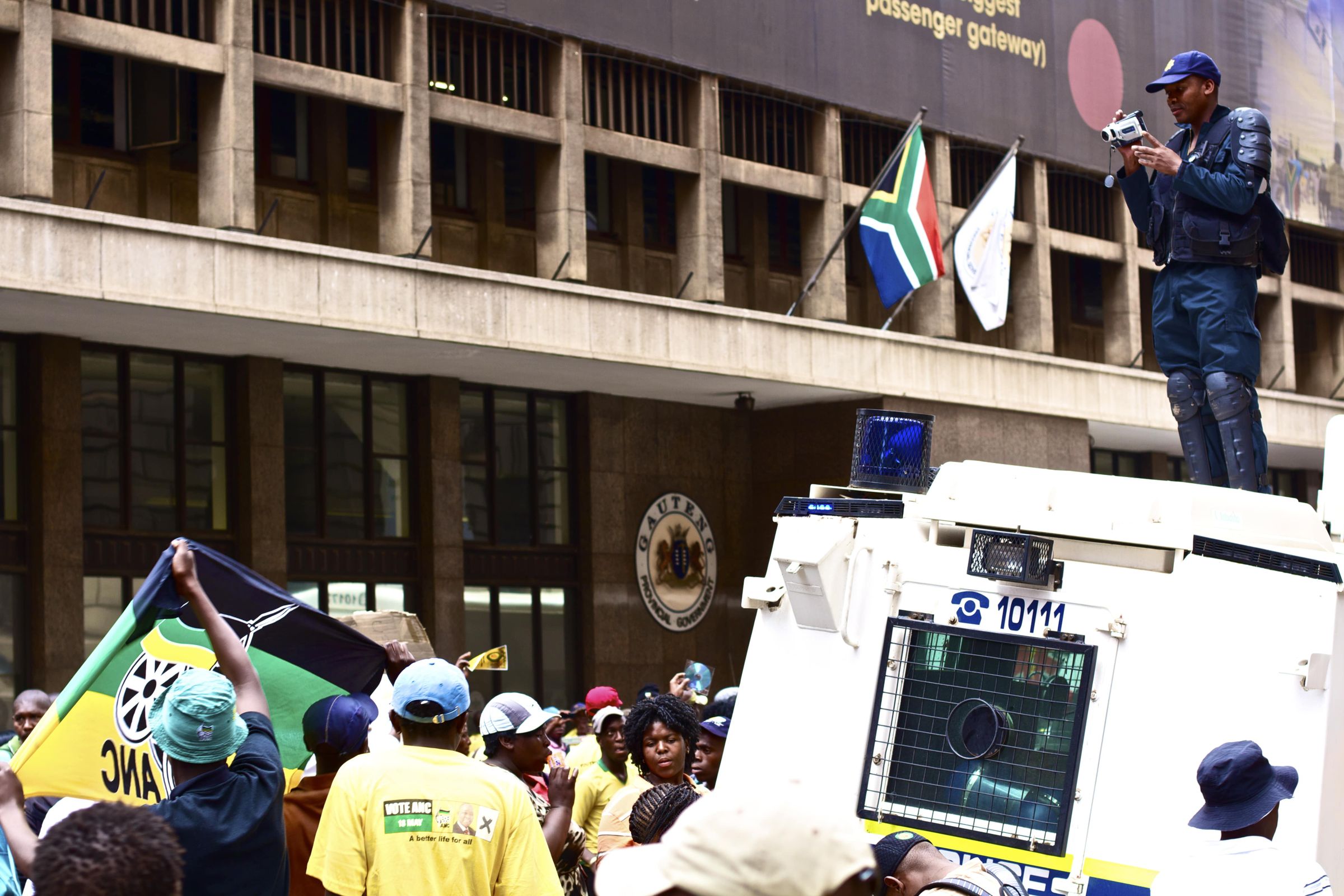
At 23 353 comparable voting stations, the ANC lost nearly 700 000 votes this year even as more South Africans went to the polls. That is the operational reality behind the party’s public framing. At the National Results Operations Centre in Midrand on Saturday, 7 November, ANC Secretary-General Fikile Mbalula presented the party’s case to the media, and the word “largest” did a great deal of heavy lifting in that briefing. The machinery of South Africa’s local elections delivered a bigger electorate in 2026. The party that has governed for decades failed to convert that expanded turnout into expanded support.
Mbalula is right that the ANC remains the largest party. With 99% of voting stations counted as at 15:00 on 7 November, it holds 30.91% of the vote, and he pointed to the municipalities it has won outright. But the IEC’s own data shows the ANC took 45.49% five years ago, and its share has since fallen by a third. The percentages flatter the party. The station-level numbers tell a harder story about whether its mobilisation operation actually worked.
The clearest evidence comes from the PCRH’s Missing Voter Tracker, which compares ward votes at the same voting stations in 2021 and 2026. At those stations, the ANC received 4 496 869 votes, down from 5 186 014, a loss of 689 145 votes, or about 13%. Over the same period, ward votes cast rose from 11 496 662 to 14 576 511, an increase of 3 079 849, or 27%. Turnout of registered voters at these stations climbed from 45.6% to 52.3%. The usual explanation for a governing party’s decline in a local election is that its supporters stayed home. On its own, that explanation cannot survive these numbers. More South Africans came out to vote, and fewer of them chose the ANC.
The party’s lead over its nearest rival has also eroded sharply. In 2021, at these stations, the ANC won more than twice as many votes as the DA, leading by 2 707 890. This year the ANC leads by 937 176, barely a quarter ahead. Nearly two-thirds of the gap has gone in a single term.
Meanwhile, the arithmetic of where the new votes came from is unusually clear. According to the PCRH’s Missing Voter Tracker analysis, the parties that grew gained 4 025 092 votes at these stations, while the only two major ones that shrank, the ANC and the EFF, lost 945 243. Even if every lost vote went to a rival, at least 3 079 849 of the gains came from people who did not cast a ward vote at these stations five years ago. That is three-quarters of all the growth, pointing to mobilisation, bringing new people to the polls, rather than persuasion, winning over other parties’ voters. The DA grew by 1 081 569 votes, more than the ANC and EFF lost combined. MK drew 1 392 945 votes in its first local election, also more than those two parties’ combined losses. Both, in other words, must have drawn new voters. ActionSA more than tripled its vote.
The largest constituency in this election, however, cast no vote at all. According to the IEC, about 15.9 million of 29.2 million registered voters cast a ballot, meaning some 13.3 million stayed home, about 84 for every 100 who voted. Using Ipsos estimates that 44.9 million South Africans are eligible to vote, some 15.7 million eligible citizens never registered at all. That puts roughly 29 million South Africans outside the outcome, almost the size of the entire voters’ roll and nearly twice the number who voted. The ANC’s roughly 4.5 million ward votes at these stations amount to about one in ten of the eligible electorate. Being “largest” means coming first among those who voted; it does not mean winning the electorate. That absent majority weakens the ANC’s mandate, and every other party’s too.
The pattern is sharpest in the Eastern Cape, Limpopo, and North West, where more registered voters stayed home than voted. The ANC still leads in all three provinces, and in Limpopo and North West its vote grew. Its heartland is not collapsing, but it appears to be under-mobilised: the voters it most needs are the ones staying home.
The temptation after a result like this is to treat 2029 as distant when it is not. Anyone who has run a campaign knows that election time is like airport time. You arrive with hours to spare, and departure feels far off. Then come the queues, the security line, the gate that has moved, and the time that felt generous is gone. The gate closes whether you are ready or not. As Steve Jarding, the campaign strategist and former Harvard Kennedy School lecturer, told our team during a masterclass, “In a campaign, time is your friend, until it isn’t.”
Between now and the 2029 national elections lie coalition negotiations, municipal budgets, candidate selection, and registration drives. Registration closes long before polling day, and the voters who moved in 2026, when about a fifth of the vote shifted between parties, will not wait for a campaign to remember them.
The accurate reading of the data is not that the ANC is finished, nor that its rivals have won the country. It is that no party inherits loyalty anymore; loyalty is earned again, ward by ward, and the largest constituency is still waiting to be reached. Percentages tell us who won, but voter numbers tell us who took part, and who did not. The parties that lead in 2029 will be those that start now, counting who left in 2026, and where. The clock is already running.
Delta Milayo Ndou is Executive Lead of the Political Campaigns Resource Hub (PCRH), a subsidiary of the International Centre for Political Campaigns (ICPC). She is a campaign strategist with a decade of experience, and co-convenes How to Run and Manage a Winning Campaign, an executive short course run by PCRH and the University of Cape Town. @MilayoNdou