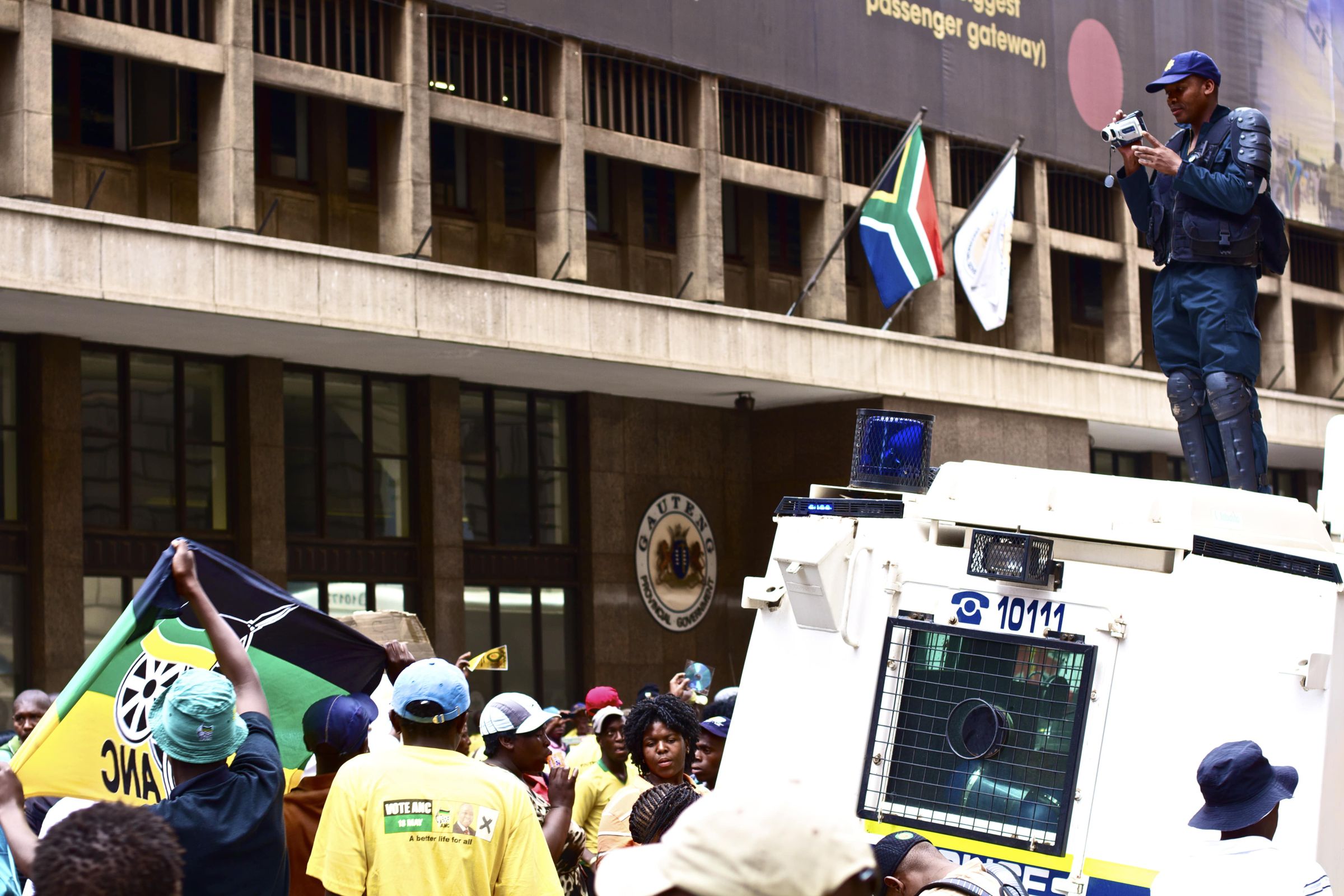
For residents of Johannesburg and other Gauteng metros, the question of who governs their councils remains unresolved, and the answer now hinges on negotiations behind closed doors. The African National Congress, having lost its majorities in every metropolitan municipality in the province, is considering asking the South African Communist Party to hand over proportional representation seats in various councils, a move that would determine who gets to lead local governments and deliver services to millions of people.
The stakes are concrete. Because the ANC won no PR seats in Johannesburg, none of its mayoral candidates in the city, including Dada Morero, Loyiso Masuku and Frank Chikane, secured a place in council. If the SACP agreed to donate its seats, at least one of those candidates could be brought into the chamber. Speaking to the Mail & Guardian this week, a senior member of the Gauteng Provincial Task Team said convenor Panyaza Lesufi had informed members of a possible approach to the SACP and other parties to request their PR seats. The same source expressed doubt, noting the strained relationship between the two parties. “I’m not sure how this is going to work, but I don’t think the SACP would allow their candidate not to go to council and then field them with an ANC person,” the source said.
The SACP has signalled resistance. Acting spokesperson Mhlekwa Nxumalo said any trade-off involving councillors would not form part of the party’s negotiations, because the councillors elected to represent it were chosen by communities, civic organisations and traditional leaders, and the seats belonged to those formations. “We are not going to enter any negotiations regarding those changes,” he said. He added that formal engagement had not yet begun; the party had met the previous day to set minimum standards that would guide its negotiations. Among those conditions: the ANC must not work with the Democratic Alliance or the Freedom Front Plus if it wants SACP support, and any breach would prompt the party to withdraw its backing from a coalition.
An ANC National Executive Committee member confirmed that engaging the SACP about PR seats in some Gauteng councils was under consideration, though the conversations remained informal. The SACP, for its part, had already approached the ANC to discuss coalitions.
Behind all of this sits a party reckoning with its worst electoral performance in its history. In 2024, the ANC lost its outright majority for the first time since 1994, and in the recent local government elections it received 32.5%, down from 47.5%, losing its majorities in all Gauteng metros. That collapse is what has thrust coalition bargaining to the centre of political life, with direct consequences for how municipalities will be run.
At a meeting at the Birchwood Hotel in Ekurhuleni on Thursday, the NEC gathered to chart the party’s approach to coalition negotiations. The parties of the left, including the Economic Freedom Fighters, the SACP and the uMkhonto weSizwe Party, held their own meeting covering coalition arrangements. ANC spokesperson Mahlengi Bhengu told journalists that the party had adopted no position on which partners to work with, and would assess all the risks associated with coalition arrangements. In municipalities where the ANC won outright majorities, she said, systems were already being put in place so councillor nominees could begin implementing manifesto commitments. She noted that conversations with various parties had occurred but nothing formal, and that the ANC had not approached any party, though several had approached it.
The leadership question has added another layer. Former president Thabo Mbeki said in a podcast this week that President Cyril Ramaphosa would be making the correct decision were reports of his considering resignation accurate, arguing that leaders normally resign when their parties experience major disasters. “The leadership takes responsibility. We are at fault. [Fikile] Mbalula called it a catastrophe. How do you continue to lead when you are responsible for a catastrophe?” Mbeki said, adding that perhaps the leadership should take the same position. Bhengu responded that Mbeki had every opportunity to engage the ANC leadership and that the party strongly supported that, though she had no knowledge of whether he had been engaged about his concerns.
ANC Youth League president Collen Malatji pushed back on calls for wholesale resignation, telling the M&G that if the entire leadership stepped down it would amount to closing the party and worsen its situation. He argued that all NEC members, not just the top seven, should take responsibility for the decline, and that doing so meant being willing to be guided on how best to move the country forward. “The NEC is the highest decisionmaking body of the ANC between conferences. There’s no structure that can appoint a structure above it. When we say they must be disbanded, it means you are saying the ANC must close.” On coalitions, Malatji said it was imperative the ANC work with the SACP, calling the DA a “no-no” whose positions the party did not share, and describing the Freedom Front Plus as a racist organisation.
Meanwhile, ActionSA’s posture in Gauteng is being watched closely. Some in the ANC believe the party is playing hardball with the DA and will eventually work with it because both are funded by the same people. ActionSA president Herman Mashaba told the M&G his party had concluded a working agreement with the Patriotic Alliance and the ANC in Laingsburg Municipality in the Western Cape, where ActionSA would take the mayoralty and the parties were finalising the deal. “It was going to be easy to work with the DA because we would have governed together, but they opted to ignore us,” he said, adding that this reflected the DA’s attitude, as it had in 2021. Negotiations in Gauteng, he said, were ongoing, and ActionSA had not met the DA in the province.
For the public, the outcome of these manoeuvres will shape who holds power in the councils that deliver water, housing and other everyday services across Gauteng. Whether the ANC can secure the seats it needs, and on whose terms, may decide who answers the phone the next time a tap runs dry.