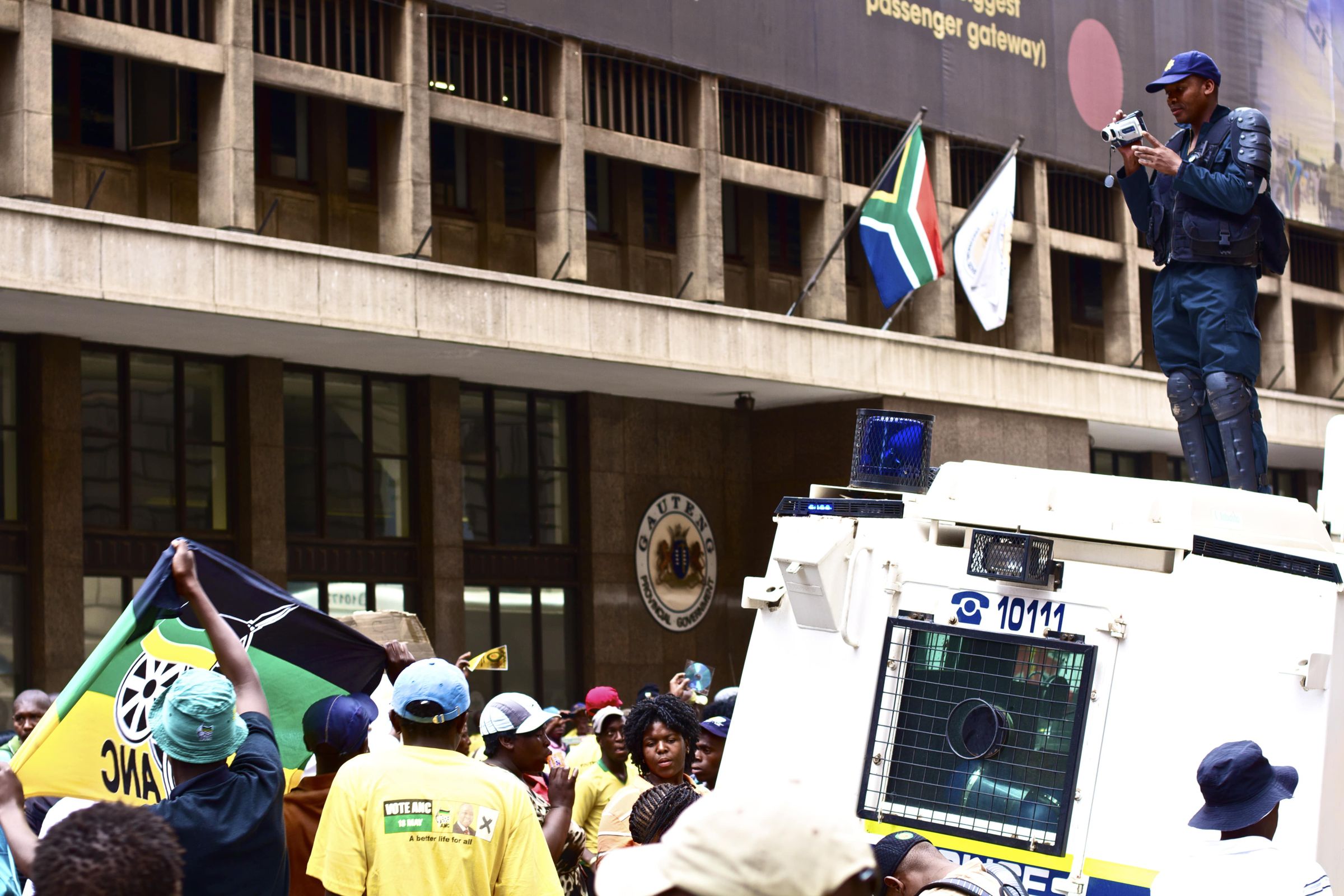
South Africa’s municipal elections delivered a verdict on the African National Congress, but reading the result as a simple punishment of one party risks obscuring the economic story underneath: a country where 23 million people survive on less than R1,300 per person per month, where up to 17 million live below the food poverty line of R800, and where investors and market-watchers have every reason to worry about what comes next.
The numbers sketch an economy under strain. Unemployment stands at a terrifying 33.7%, with youth unemployment at 47.3%, leaving young people competing for work cleaning cars in parking lots. A 2023 annual survey by the FinMark Trust found that 40% of South African households, not only black households but South African households in general, borrow money for the next meal. The United Nations Children’s Fund reports that two million children go to bed hungry every night. Informal settlements have emerged in which white residents live alongside the previously oppressed, a sign that the poverty crisis cuts across the racial lines that usually dominate the country’s politics.
The ANC was punished for this disarray, and rightly so, particularly the collapse in municipal service delivery. Yet the party is not the sole actor in the economy it inherited. Those in the inherited power bloc, political, economic and social, have worked to protect or recoup past privileges. The ANC passed laws and interventions grounded in public interest but could not overcome a silent and brutish resistance, including challenges to transformation that reached the Constitutional Court. The private sector initiated programmes to overcome the past, but these have lost momentum. The party itself also lacked grit and passion in implementation, a lost opportunity at a time when it enjoyed mass support.
For the business community, the stakes are sharpened by the political aftermath. Some political actors appear gleefully focused on winning wards off the ANC rather than serving society, treating governance as a matter of “our turn.” If desperation among black South Africans feeds a rising populism, governance may become a swinging door as party after party rotates in. Unattainable promises could breed anarchy, uncertainty would become the order of the day, and the country’s standing in the global economy could be shattered as confidence in the economy falls and investment suffers.
Against that backdrop, the author of the argument, writing in Daily Maverick, identifies priorities that are fundamentally economic. The first concerns barriers to entry. Research centres have produced volumes showing how new black entrants are barred from the economy, and failure to enter markets feeds unemployment. The government recently released a report on eradicating red tape, but it focused only on reduction of red tape within government and excluded the private sector, which carries massive red tape of its own that keeps new entrants out. Very little is said or done about these private-sector barriers.
The second is Broad-Based Black Economic Empowerment. For as long as the main focus is redistribution, the policy will have limited success in integrating black South Africans into the economy, and unemployment will worsen. The proof is in the record: despite 15 years of BBBEE and numerous amendments, unemployment worsened year after year. The policy itself remains critical for the future, the argument holds, but it needs a better model and, above all, measurable, impactful and integrity-driven implementation of the enterprise and supplier development leg. The emphasis must shift to economic growth, getting as many black South Africans as possible to be producers and entrepreneurs. Proven models for community entrepreneurship exist, including China’s shared economy prototype, summed up in the phrase “raise the ocean and all boats will float.”
Meanwhile, the third priority is corruption, which the argument insists is not a government-only affair. It involves the private sector as well, is fully nonracial, and is fast becoming the norm. Fourth, accountability is lacking: for as long as the black middle class and intelligentsia do not hold leaders to account, conditions will not improve. Swathes within these groupings, with some isolated instances of black responsibility and conscience, are simply not playing their role as custodians of morality and accountability.
The appeal, the writer stresses, is not a defence of the ANC but a call for an honest appraisal. Nelson Mandela’s democratic South Africa, despite real developmental progress, remains a nation of two distinct societies, one luxuriating while the other swirls in poverty. The most important issue remains food on the table and a place in the sun for the young. For the author personally, the most painful aspect of the ANC’s defeat, suffered in a free and fair election, is its impact on the black child’s psyche and pride, the embedding of a belief that blacks cannot rule. That is how deeply the result cuts, and why the crisis it reflects demands more than blame. Whether the country’s investors and policymakers can convert that reckoning into growth before confidence drains further is the question that now hangs over the economy.